
Obstacle avoidance for personal mobility products is not simply about detecting what is directly in front of the vehicle. In real environments, obstacles can appear at different heights, positions, and distances. Steps, curbs, low objects, and changes in ground level can all affect how a power chair or mobility scooter moves through a space.
SCIFFTO AiPass is developed to address this challenge through a wider environmental perception approach.
Instead of relying on a single detection direction, AiPass combines high definition matrix LiDAR, ultrasonic radar, and rearview vision to help the vehicle perceive more of its surrounding environment.
The result is an intelligent sensing system designed around one practical requirement: helping personal mobility products better understand the space in which they are moving.
Why Vertical Recognition Matters
Many obstacles encountered by mobility products are not positioned at a single standard height.
A curb may rise from the ground. A step creates a change in elevation. A low stool or object may sit below the main detection level. In narrow indoor environments, furniture and other objects can also appear at different heights relative to the vehicle.
This means that horizontal detection alone may not provide enough information.
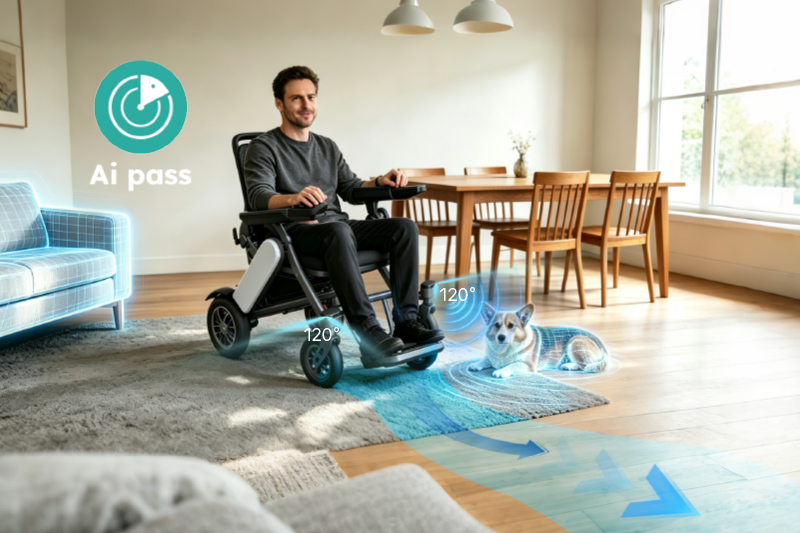
AiPass introduces 120 degree vertical recognition to expand the sensing perspective.
By increasing the vertical field of perception, the system can gather information across a broader range of heights instead of focusing only on objects positioned along one horizontal level.
This is particularly relevant for power chairs and mobility scooters because they frequently operate close to the ground and around objects in homes, public facilities, corridors, and other confined environments.
From a Single Detection Point to Area Perception
The challenge with obstacle detection is not simply how far a sensor can detect.
It is also how much of the surrounding environment the system can understand at the same time.
AiPass uses an 8 by 8 sensing matrix with 64 detection points to create area-based perception.
Instead of depending on one point of detection, the matrix collects information across multiple positions. This helps the system recognize obstacles that may not be directly centered in the vehicle's path.
For a mobility product moving through a narrow space, this difference can be important.
An obstacle may be slightly to one side. A low object may appear below the main detection line. A change in ground height may occur directly ahead.
Area perception provides more information for the system to process before the vehicle reaches the obstacle.
Combining LiDAR and Ultrasonic Detection
AiPass does not depend on one sensing technology alone.
Its high definition matrix LiDAR provides spatial information across the detection area, while high definition ultrasonic radar adds another layer of nearby object detection.
The two technologies serve complementary roles.
LiDAR can provide detailed spatial information, including changes in object position and height. Ultrasonic sensing can support close range detection around the vehicle.
Combining different sensing methods can help reduce the limitations associated with relying on a single sensor type.
For personal mobility equipment, this is particularly useful because operating environments can change quickly from open areas to narrow spaces and from clear floors to areas containing small or irregular obstacles.
Understanding the Environment Before the Vehicle Moves Through It
Dynamic obstacle avoidance requires more than simply identifying an object.
The system needs to understand where an obstacle is located relative to the vehicle and provide useful information for movement decisions.
AiPass is designed around this concept.
Its sensing architecture combines matrix perception, vertical recognition, LiDAR, ultrasonic radar, and rearview vision to build a broader picture of the surrounding environment.
This supports intelligent functions such as dynamic obstacle avoidance and safety-oriented movement assistance.
The technology is intended to work as part of the vehicle control system rather than as an isolated warning device.
Rear Visibility Completes the Perception System
Environmental awareness should not stop at the front of the vehicle.
When reversing, users may have limited visibility of the area behind a power chair or mobility scooter. This can become particularly challenging in narrow indoor spaces or when maneuvering close to furniture and walls.
AiPass therefore incorporates a high definition rearview camera to improve the field of view during reversing.
The camera provides visual information from behind the vehicle, complementing the sensing information generated by the LiDAR and ultrasonic systems.
Together, these technologies help create a more complete perception system covering different directions and operating conditions.
Designed Around Real Mobility Environments
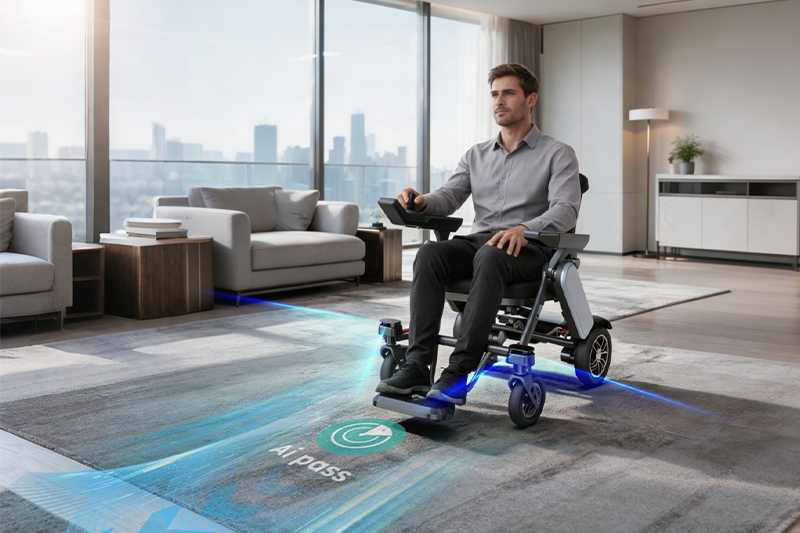
Personal mobility products operate in environments that are very different from controlled industrial systems.
A user may move from a living room into a narrow corridor, approach an elevator, pass through a doorway, or encounter a curb or uneven surface outdoors.
The environment can change within seconds.
This is why an intelligent mobility system needs to consider not only long distance detection, but also close range objects, vertical changes, side areas, and rear visibility.
AiPass is designed around these practical conditions, using multiple sensing technologies to provide broader environmental information.
Beyond Obstacle Detection
Obstacle detection is only the starting point.
For intelligent mobility, the larger objective is to connect environmental perception with vehicle behavior.
AiPass is positioned as part of a broader safety system that includes dynamic obstacle avoidance and fall or tipping prevention.
This approach moves intelligent mobility beyond a simple sensor warning function.
The vehicle can use environmental information as part of its control logic, helping support more controlled movement in complex spaces while keeping the user involved in the driving process.
A Technology Platform for Intelligent Mobility
AiPass is designed for personal mobility equipment including power chairs and mobility scooters.
Its architecture combines sensing hardware, environmental perception, vehicle control, and user information into a unified intelligent mobility system.
An HD TFT LCD display can also provide clear vehicle status information, allowing users to better understand the operating condition of the vehicle.
For OEM and customization projects, this type of integrated technology can provide a foundation for developing different intelligent mobility configurations according to product positioning and market requirements.
What 120 Degree Vertical Recognition Adds to Mobility
The key value of vertical recognition is not simply a larger sensing number.
It changes what the vehicle can perceive.
When obstacles exist at different heights, a wider vertical perception range provides more information about the environment before the vehicle reaches the object.
Combined with 64 point matrix sensing, LiDAR, ultrasonic radar, and rearview vision, the system is designed to provide a more complete environmental picture.
For personal mobility products, this can support a more responsive approach to navigating narrow, irregular, and changing environments.
Moving Toward More Intelligent Personal Mobility
The development of intelligent mobility is shifting from basic powered movement toward systems that can better understand their surroundings.
SCIFFTO AiPass represents this direction by combining 120 degree vertical recognition with multi sensor environmental perception.
Rather than treating obstacle avoidance as a single feature, AiPass integrates sensing and vehicle intelligence into a broader approach to mobility safety.
For power chair and mobility scooter manufacturers, distributors, and OEM partners, this creates new possibilities for developing products that provide users with greater environmental awareness and more intelligent movement assistance.
Frequently Asked Questions
Q: What is SCIFFTO AiPass?
A: AiPass is an intelligent obstacle avoidance and environmental perception system developed for personal mobility products such as power chairs and mobility scooters.
Q: What is 120 degree vertical recognition?
A: 120 degree vertical recognition expands the sensing perspective vertically, allowing the system to perceive environmental features across a wider range of heights.
Q: How many detection points does AiPass use?
A: AiPass uses an 8 by 8 sensing matrix with 64 detection points for area-based environmental perception.
Q: What sensing technologies are used?
A: AiPass combines high definition matrix LiDAR, high definition ultrasonic radar, and a high definition rearview camera.
Q: What types of obstacles can the system help identify?
A: The system is designed to perceive environmental features such as steps, curbs, low objects, ground debris, and changes in height.
Q: Does AiPass support dynamic obstacle avoidance?
A: Yes. AiPass is designed to support dynamic obstacle avoidance by combining environmental perception with intelligent vehicle control.
Q: What mobility products can use AiPass?
A: The system is designed for personal mobility equipment including power chairs and mobility scooters, with customization possibilities for different product configurations.