
REHACARE 2026 takes place from September 23 to 26 at Messe Düsseldorf, bringing together companies and professionals from rehabilitation, care, assistive technology, and mobility. For the electric wheelchair industry, the event provides an opportunity to look beyond individual products and examine how mobility needs are changing across different applications and users.
For an electric wheelchair manufacturer, these changes raise a broader question: how should mobility products develop when everyday requirements are becoming more diverse?
Mobility Is Becoming More Application Driven
An electric wheelchair may be used at home, in a rehabilitation facility, in public buildings, during travel, or outdoors. Each environment creates different conditions for the person using the product.
A compact indoor product may need to work around furniture, doorways, and narrow passages. A travel focused product may need to be easier to transport and store. Outdoor use can create different demands on the drive system, wheels, suspension, and overall structure.
The result is a market where product development is increasingly connected to application.
The question is no longer only whether an electric wheelchair can move. It is whether the product makes sense for the environment and routine in which it will be used.
From Product Categories to Real Use Cases
Traditional product categories are useful for organizing a market, but they do not always explain what users actually need.
Two people may both be looking for an electric wheelchair while having completely different priorities.
One may need a product that fits into a home and can be managed in limited space. Another may need a solution that can be transported frequently. A different user may need stronger performance for outdoor mobility.
For manufacturers, this means product development has to start with actual use cases.
Design decisions such as size, weight, driving system, controls, structure, and intelligent functions become more meaningful when they are connected to a specific application.
This approach also gives distributors a clearer way to evaluate products. Instead of asking which product is generally better, they can ask which product is better suited to the customer group they serve.
Why Everyday Mobility Requires More Than Basic Driving
Basic powered movement is only the starting point of an electric wheelchair.
A product may also need to fit into the user's daily routine.
Transportation can affect product design. Storage can affect dimensions. Charging can affect convenience. Controls can affect how easily the product can be operated. The surrounding environment can affect maneuverability and safety requirements.
These details may seem small when considered separately.
Together, they shape whether a mobility product is practical in everyday life.
This is why an electric wheelchair manufacturer needs to look at the complete use experience rather than focusing only on the driving function.
Different Markets Create Different Expectations
Mobility requirements are not identical across countries.
Users may have different living environments. Distribution channels may be structured differently. Regulations may vary. Transportation habits and product preferences can also change from one market to another.
As a result, manufacturers working internationally cannot always assume that one standard configuration will meet every market requirement.
A product may need different specifications, configurations, documentation, or positioning depending on where it is being sold and how it will be used.
This is one reason why international mobility exhibitions remain important. They provide a place where different market perspectives can be discussed directly.
What REHACARE Brings Together
A specialist event such as REHACARE places different parts of the mobility ecosystem in the same environment.
Healthcare and rehabilitation professionals can bring application knowledge.
Distributors can bring market experience and customer requirements.
Manufacturers can bring engineering and product development capabilities.
Users can bring direct experience of everyday mobility.
These perspectives do not always lead to the same priorities, but that is exactly what makes the exchange useful.
A product requirement becomes more meaningful when it is connected to a real situation.
A question about transportation may reveal the importance of product weight and folding.
A discussion about indoor use may highlight the role of dimensions and maneuverability.
A conversation about safety may lead to new considerations around control and intelligent assistance.
What an Electric Wheelchair Manufacturer Needs to Understand
The changing mobility market creates a broader role for manufacturers.
Product development needs to consider where the product will be used, who will use it, and what happens before and after the vehicle is driven.
This can include:
Product application
User interaction
Transportation and storage
Driving environment
Technical configuration
Market requirements
Long term product support
These elements are closely connected.
A manufacturer that understands the application can make more informed engineering decisions. A manufacturer that understands the market can also better support distributors and brands when products need to be adapted for different regions.
Product Solutions Need a Clear Purpose
A broader product portfolio is only useful when each product has a clear role.
Lightweight products can address transportation and portability.
Compact products can support movement in space limited environments.
Heavy duty products can address more demanding structural and driving requirements.
All terrain products can serve more challenging outdoor conditions.
Intelligent products can add environmental awareness and driving assistance.
The objective is not simply to create more models.
The objective is to make sure each product solves a recognizable mobility problem.
For distributors, this can make product selection more practical because different models can be matched to different customer groups.
Why This Matters to Distributors and Brand Owners
For a distributor, product selection is closely connected to market positioning.
A distributor may need a lightweight product for one customer segment and a more capable outdoor platform for another.
A brand owner may also need a product range that allows the brand to cover more than one mobility application.
This makes the manufacturer's product development strategy important.
A manufacturer with a broader understanding of mobility applications can provide more than individual products. It can provide a product structure that supports different market opportunities.
For OEM and ODM partners, this can also create more room to develop products around specific market requirements.
Connecting Industry Feedback With Product Development
Product development does not happen in isolation.
Manufacturers learn from engineering tests, product use, distributor feedback, and industry communication.
Exhibitions are one part of this process because they bring many different conversations together within a short period.
The value is not simply the number of visitors.
It is the quality of the questions and the practical situations behind them.
When a manufacturer understands why customers are asking for a particular function, it can make better decisions about whether that function belongs in a product, how it should be implemented, and which users it should serve.
The Role of the Electric Wheelchair Manufacturer Is Expanding
The role of an electric wheelchair manufacturer is becoming broader as mobility applications become more specific.
Manufacturers are expected to connect product development with engineering, production, quality, compliance, customization, and market requirements.
At the same time, they need to remain connected to how products are actually used.
This creates a more complete relationship between manufacturer and business partner.
The manufacturer is not only producing a vehicle.
It is helping convert mobility requirements into a product that can be developed, manufactured, positioned, and supported in a target market.
SCIFFTO and the Broader Mobility Market
For SCIFFTO, this broader approach is reflected in the development of mobility products across different categories and applications.
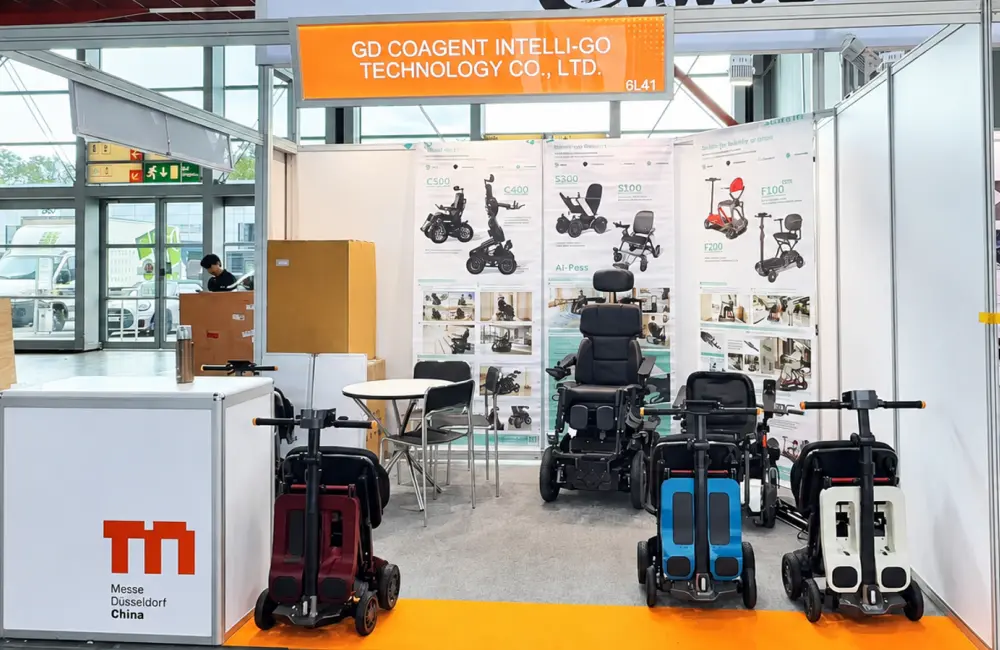
The product portfolio covers lightweight, compact, heavy duty, all terrain, and intelligent mobility directions, allowing different solutions to address different requirements.
The role of the manufacturer is to connect these product directions with real applications rather than treating them as isolated categories.
REHACARE 2026 provides an opportunity for SCIFFTO to continue that connection with distributors, professional users, industry organizations, brand owners, and OEM and ODM partners.

Looking Beyond REHACARE 2026
The mobility market will continue to change as users expect products to fit more naturally into everyday life.
Applications will become more specific.
Technology will continue to develop.
Distributors will continue to look for products that match their customer groups.
For an electric wheelchair manufacturer, staying connected to these changes is part of long term product development.
REHACARE 2026 is one point in that process, bringing different perspectives together and creating opportunities to connect industry discussions with future mobility solutions.
Frequently Asked Questions
Q: When is REHACARE 2026?
A: REHACARE 2026 takes place from September 23 to 26, 2026, at Messe Düsseldorf, Germany.
Q: Why is REHACARE important for the electric wheelchair industry?
A: The event brings together manufacturers, distributors, rehabilitation and healthcare professionals, users, and other industry participants, creating opportunities to discuss applications and changing mobility requirements.
Q: Why do electric wheelchair manufacturers need to consider different applications?
A: Electric wheelchairs are used across different environments, and each environment can create different requirements for dimensions, portability, driving performance, controls, and other product characteristics.
Q: Why is a product portfolio important for distributors?
A: Different customer groups may need different product characteristics. A broader portfolio can help distributors match products to specific applications instead of using one product for every customer.
Q: What should an electric wheelchair manufacturer provide beyond production?
A: A manufacturer may also need capabilities in product development, engineering, quality management, compliance, customization, and long term product support.
Q: Does SCIFFTO support OEM and ODM cooperation?
A: SCIFFTO works with distributors, brand owners, and OEM and ODM partners to develop mobility products according to specific product and market requirements.