
Stair accessibility remains an important consideration in mobility planning. While ramps, elevators, and accessible building layouts can support movement between different levels, not every environment has the same infrastructure or space availability.
For mobility equipment distributors, rehabilitation equipment suppliers, and institutional buyers, stair-climbing power chairs represent a specialized product category worth understanding.
However, choosing a stair-climbing mobility solution involves more than checking whether a product can climb stairs. Buyers also need to consider the operating environment, user requirements, product configuration, and intended application.
Why Stair Accessibility Matters in Mobility Planning
Different buildings present different accessibility challenges.
Residential properties, rehabilitation facilities, older buildings, and public environments may have stairways that cannot easily be replaced or modified.
In these situations, specialized mobility equipment may be considered as part of a broader accessibility plan.
For professional buyers, the first step is understanding the actual environment in which the equipment will operate.
Important considerations include:
- Stairway layout, width, and dimensions
- Stair surface and overall condition
- Available space at the top and bottom of the stairs
- Landing areas and turning space
- Obstacles along the intended route
- Expected frequency of use
- Availability of trained operating assistance
These factors help determine whether a particular stair-climbing solution is suitable for a project.
Understanding Stair-Climbing Power Chair Design
A stair-climbing power chair is designed for a specialized mobility application involving stairway access.
Unlike conventional powered wheelchairs that primarily operate on flat or suitable ground surfaces, stair-climbing models incorporate a dedicated mechanism for navigating compatible stairways.
Different manufacturers may use different engineering approaches, operating mechanisms, and product configurations.
For professional buyers, understanding the actual operating system is important when comparing products.
The evaluation should cover how the chair transitions between operating modes, how the user is supported during stairway movement, and what operating conditions are required.
Wheeled and Tracked Operating Modes
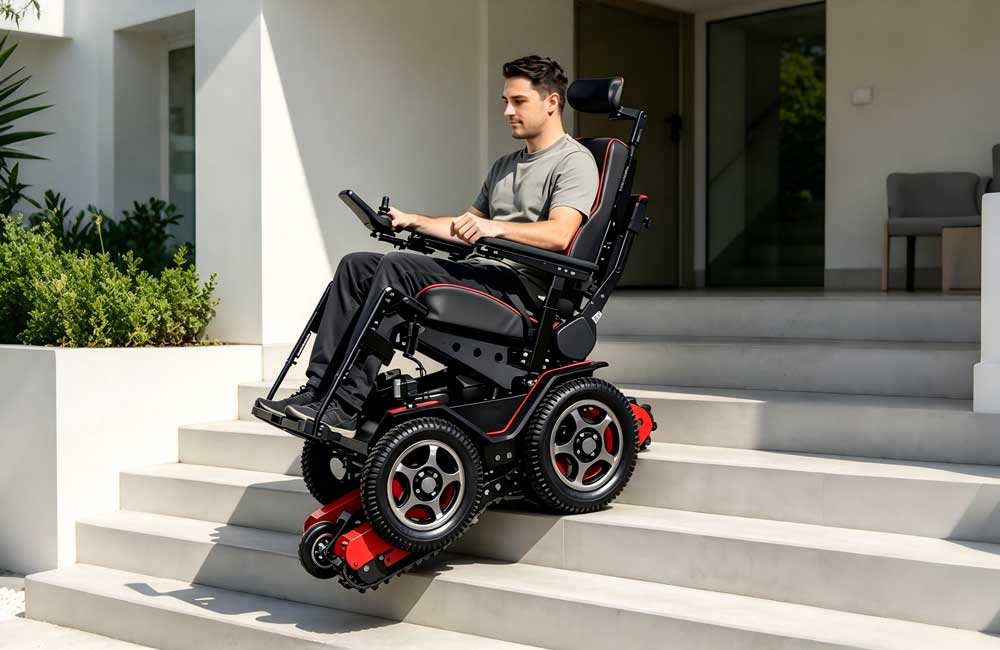
Some stair-climbing power chairs combine conventional wheeled mobility with a tracked stair-climbing system.
This approach allows the equipment to use different operating configurations according to the intended surface and application.
For example, wheeled operation may be used on suitable paved surfaces, while the dedicated tracked system is intended for compatible stairways.
The SCIFFTO C400 Stair-Climbing Power Chair follows this design approach, combining a powered crawler platform with wheeled and tracked operating modes.
When evaluating this type of equipment, buyers should understand the conditions required for each mode and follow the manufacturer's operating instructions.
What Distributors Should Evaluate Before Purchasing
For distributors and mobility equipment suppliers, product selection should begin with the needs of the target market.
A product that fits one project may not necessarily be suitable for another.
The following areas deserve particular attention.
1. Operating Environment
Evaluate the types of stairways, surfaces, and surrounding spaces where the equipment will be used. Different stairway structures may create different operating requirements.
2. User Requirements
Consider user size, positioning requirements, support needs, and the level of assistance required during operation.
3. Operating Modes
Understand how the product operates on regular surfaces and how its stair-climbing mechanism is activated and controlled.
4. Training and Safety Procedures
Stair-climbing equipment requires proper operator training and compliance with manufacturer instructions. Buyers should establish appropriate operating and supervision procedures before deployment.
5. Product Support
For long-term distribution or institutional projects, spare parts availability, technical support, maintenance procedures, and after-sales service should also be considered.
Why Product Demonstration Matters
Specifications and product descriptions provide useful information, but they cannot replace practical evaluation.
A product demonstration allows distributors and professional buyers to better understand its operating process, user support arrangement, and handling requirements.
For stair-climbing equipment, demonstrations should be conducted under controlled conditions using compatible stairways and trained operators.
This helps buyers assess whether the product's operating characteristics align with the intended project.
It also provides an opportunity to discuss configuration requirements, training arrangements, and ongoing technical support.
Introducing the SCIFFTO C400 Stair-Climbing Power Chair
The SCIFFTO C400 Stair-Climbing is developed for specialized stair-access mobility applications.
Its design combines a powered crawler platform with wheeled and tracked operating modes, allowing the equipment to be configured for different suitable surfaces and intended uses.
The product also incorporates adjustable seating components, user-support features, attendant controls, and a multifunctional LCD remote.
For distributors, rehabilitation equipment suppliers, and institutional buyers, the C400 Stair-Climbing provides a product option to evaluate when developing mobility solutions for multi-level environments.
The appropriate configuration and operating conditions should always be assessed against the intended application.
For more product information, visit the SCIFFTO Stair-Climbing Power Chair C400.
Building a Suitable Mobility Solution for Different Environments
Stair accessibility is only one part of a broader mobility planning process.
Professional buyers may need to consider how equipment fits into existing facilities, how users are supported, and what operational arrangements are required.
A careful evaluation of the environment, user requirements, and product capabilities helps establish a more practical purchasing decision.
For distributors and institutional partners, understanding these factors is also important when introducing specialized mobility equipment into different markets.
Business Partnership & Project Inquiries
SCIFFTO works with mobility equipment distributors, rehabilitation suppliers, and business partners across different markets.
Whether you are evaluating stair-climbing power chairs for regional distribution, institutional procurement, or a specific mobility project, understanding the application requirements is an important starting point.
We welcome inquiries from:
- Mobility equipment distributors and regional partners
- Rehabilitation equipment suppliers
- Healthcare organizations and institutions
- OEM and ODM business partners
- Organizations developing specialized mobility projects
Our team can discuss product information, cooperation opportunities, and project requirements based on your business needs.
Looking for a stair-climbing mobility solution for your market or project?
Visit our SCIFFTO C400 Stair-Climbing product page to explore the product.
For distribution cooperation, OEM/ODM opportunities, and institutional inquiries, visit our SCIFFTO Partnership Overview and Business Inquiry Page and submit your business inquiry directly to our team.
We look forward to discussing potential cooperation and mobility projects with you.