
Flying with an electric wheelchair is possible for most travelers. The main challenge is the lithium battery. Different airlines give different answers, and outdated information is common. This guide explains the 2026 rules clearly so you can prepare and avoid problems at the airport.
The rules are based on IATA Dangerous Goods Regulations (67th Edition), ICAO Technical Instructions, FAA PackSafe, and major airline policies worldwide. Final acceptance always depends on the airline. Written confirmation before travel is the safest approach.
Why Mobility Aid Battery Rules Differ from Ordinary Devices
Rules for Everyday Electronics
Phones, laptops, and power banks follow strict limits. Batteries of 100 Wh or less are normally accepted without approval. Batteries between 101 Wh and 160 Wh need airline approval, with a maximum of two spares. Anything above 160 Wh is usually forbidden on passenger flights.
Special Provisions for Mobility Aids
Wheelchairs and mobility scooters used by people with reduced mobility follow different rules. These appear in IATA DGR section 2.3.2.4. The device is treated as an assistive aid, not ordinary baggage. This allows higher and more flexible limits when the correct procedures are followed. Only genuine mobility aids qualify. Recreational scooters and hoverboards do not.
2026 Global Core Rules in Detail
The worldwide baseline set by IATA and ICAO is consistent. Three main situations cover almost every case.
Batteries That Remain Installed in the Wheelchair
When the battery is protected by the wheelchair design, securely attached, and the circuits can be isolated, many airlines allow it to stay in place. There is often no fixed watt-hour limit. If the total energy exceeds 300 Wh, the airline may require extra safety measures such as a fire-resistant cover or a reduced charge level (commonly 25% or less). The wheelchair travels in the aircraft hold.
Batteries That Must Be Removed
If the battery is not well protected or must be removed for folding, it has to come out. A single removed battery must not exceed 300 Wh. It must travel in the passenger cabin and cannot go in checked baggage. Terminals need insulation against short circuit, and the battery should sit in a protective pouch.
Spare Batteries
Passengers may carry one spare battery up to 300 Wh, or two spare batteries each up to 160 Wh. All spare batteries must also stay in the cabin under the same protection rules.
Summary of Core Limits
|
Battery Situation |
Maximum Limit |
Carriage Location |
Key Conditions |
|
Installed and protected by design |
Usually no fixed Wh limit |
With wheelchair (hold) |
Power off, freewheel mode, securely attached |
|
Battery must be removed |
300 Wh (single battery) |
Cabin only |
Terminals insulated, protective pouch required |
|
Spare batteries |
1 × 300 Wh or 2 × 160 Wh each |
Cabin only |
Same protection rules as removed batteries |
Additional Mandatory Requirements
Every lithium battery must have passed the UN 38.3 tests. Airlines may ask for proof. The wheelchair itself travels free as an assistive device and does not count toward normal baggage limits.
How to Calculate Watt-Hours Accurately
Watt-hours equal voltage multiplied by amp-hours. A 24 V 6 Ah battery contains 144 Wh. A 24 V 10 Ah battery contains 240 Wh. Always read the label on the actual battery you will use. Take clear photographs of the voltage, capacity, and any printed Wh figure. These photos help both with airline notification and at the airport.
Deciding Whether the Battery Should Be Removed
Protected Design Versus Easy Removal
The decision depends on how the wheelchair is built. If the battery is enclosed in a strong housing that forms part of the frame and cannot be removed without tools, many airlines accept it remaining installed. The device must still be powered off and placed in freewheel mode. Lightweight folding models are usually designed so the battery lifts out easily. In these cases airlines almost always require removal. When there is any doubt, preparing to remove the battery is the safer choice.
How Rules Are Applied in Different Regions
The numerical limits stay similar worldwide. Differences appear mainly in notification timing and how strictly the rules are enforced.
United States
The FAA follows the same 300 Wh and 160 Wh figures. Major carriers such as Delta, United, American, and Southwest generally accept these limits. Southwest requires removable lithium batteries to travel in the cabin. Advance notice of at least 48 hours is strongly recommended.
Europe
European airlines follow the IATA framework. Clear documentation of the watt-hour rating and UN 38.3 compliance is often requested. Advance notification is standard.
China
Chinese rules set a limit of 300 Wh for a single battery or 160 Wh for each of two batteries. Spare batteries follow the same ceilings. Some carriers prefer or require 72 hours written notice. The wheelchair itself must be checked and cannot enter the cabin.
Australia
Carriers such as Qantas require formal Dangerous Goods approval. Easily removable batteries must be removed, protected, and carried in the cabin within the standard limits.
Asia and the Middle East
Airlines including Singapore Airlines, Cathay Pacific, and Emirates place strong emphasis on advance approval and complete documentation. Proof of UN 38.3 testing is frequently requested. Removed batteries must stay with the passenger in the cabin.
Regional Comparison Overview
|
Region |
Typical Notice Period |
Battery Removal Tendency |
Special Notes |
|
United States |
48 hours |
Often required for folding models |
Southwest is among the stricter carriers |
|
Europe |
48 hours |
Case-by-case |
Strong focus on documentation |
|
China |
48–72 hours |
Required for most lithium packs |
Wheelchair must be checked |
|
Australia |
Advance approval |
Required if easily removable |
Formal Dangerous Goods process |
|
Asia / Middle East |
48 hours or more |
Frequently required |
UN 38.3 proof commonly requested |
Complete Pre-Flight Preparation Process
Good preparation is the factor that most reliably prevents problems.
Seventy-Two to Forty-Eight Hours Before Departure
Contact the airline’s special assistance or dangerous goods department. Provide the exact wheelchair model, battery chemistry, watt-hour rating, and clear photographs of the battery label. State whether the battery is removable. Request written confirmation. If the journey includes connecting flights on different carriers, confirm the rules for each segment.
The Day Before Travel or the Morning of Departure
Charge the battery fully unless the airline has asked for a lower state of charge. Prepare a protective pouch or rigid container. Keep the manufacturer’s instructions that explain how to power the device off, remove the battery, and engage freewheel mode. Save digital and printed copies of the airline confirmation and battery details.
At the Airport
Arrive earlier than usual. Go first to the special assistance desk. Be ready to demonstrate the power-off and freewheel procedures if staff request it. Once the battery is removed, keep it with you in the cabin for the entire journey. The wheelchair is normally returned at the aircraft door on arrival.
SCIFFTO Models and Their Suitability for Air Travel
R100 Series
The R100 series is designed with frequent air travel in mind. The carbon-fiber frame weighs 9.8 kg without the battery. It folds in one step to 56 × 27 × 43 cm. Removable lithium battery options include a 6Ah version created for airline compatibility. Batteries of this capacity typically stay well below the 160 Wh and 300 Wh thresholds, though the exact figure must always be checked on the label. The combination of very low weight, compact folded size, and easily removable battery makes the R100 one of the most practical choices for regular flyers.
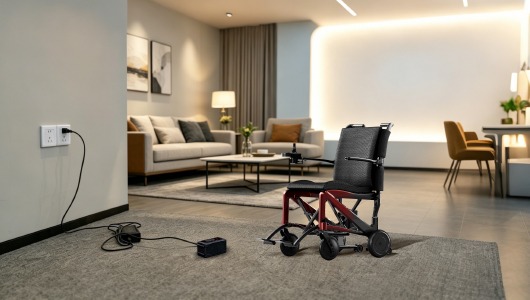
Full details and further travel advice are available on the R100 Series and in the R100 Travel Guide.
E100 Series
The E100 is a lightweight folding power chair built for daily use and short trips. It offers a compact fold and removable battery options. When fitted with a suitable battery, it works well for air travel. Travelers should still confirm the exact watt-hour rating before flying.
S300 / S300 Plus Series
The S300 and S300 Plus are heavy-duty models focused on stability and higher weight capacity. They use larger batteries than the R100 or E100. These models can still meet airline rules, but the higher capacity means users must check the precise Wh rating in advance. Extra documentation or battery removal may be required on some flights.
Model Suitability Snapshot
|
Model Series |
Weight Profile |
Battery Style |
Air Travel Suitability |
Notes |
|
R100 |
Ultra-light (9.8 kg) |
Easily removable |
Highest |
6Ah option designed for airline use |
|
E100 |
Light |
Removable |
High |
Compact folding design |
|
S300 / S300 Plus |
Heavier |
Higher capacity |
Moderate |
Confirm exact Wh rating in advance |
Common Causes of Refusal and How to Prevent Them
Most refusals happen for a few preventable reasons. The airline received no advance notice. The battery label is missing or unclear. The terminals are left unprotected. The passenger cannot show how to power the device off or remove the battery. Staff or the passenger incorrectly apply the stricter rules that apply to ordinary power banks. Following the preparation steps above removes nearly all of these risks.
Summary of the Essential Points
Mobility aid batteries follow special rules that are more flexible than those for consumer electronics. The main global limits are 300 Wh for a single removed battery and 160 Wh for each of two spare batteries. All removed and spare batteries must travel in the cabin. Advance notification of 48 to 72 hours plus clear documentation is the most effective way to ensure smooth acceptance. Lightweight folding wheelchairs with easily removable batteries of moderate capacity remain the simplest option for frequent air travel.
Conclusion
The SCIFFTO R100 series is a practical choice for air travel. Its ultra-light carbon fiber frame and one-step folding meet current airline needs, while removable battery options further improve compatibility. Contact the SCIFFTO team for battery details or trip support. Always confirm the latest rules with your airline before flying.
FAQs
What is the maximum Wh allowed for a removed battery?
The maximum for a battery that must be removed is 300 Wh. Spare batteries are limited to one unit of 300 Wh or two units of 160 Wh each.
Is battery removal always required?
Removal is not required in every case, but it is the normal expectation for most lightweight folding models. The design of the wheelchair decides the outcome.
Can spare batteries be taken on the flight?
Spare batteries are allowed within the stated limits and must be carried in the cabin.
Are the rules identical on every airline?
The numerical limits are largely the same worldwide. Differences appear mainly in the required notice period and day-to-day enforcement. Confirmation with the specific airline is essential.
Which SCIFFTO model works best for frequent flyers?
The R100 series with the 6Ah battery option currently offers the strongest combination of low weight, compact folded size, and airline-compatible battery design.
What battery charge level is recommended?
A full charge is acceptable in most situations. Some airlines may request a lower state of charge for higher-capacity batteries. It is best to ask this question when making the advance notification.