
Reversing looks simple, but it can become one of the more difficult moments when operating a mobility scooter.
The driver's view is naturally focused toward the front, while walls, furniture, other vehicles, or people may appear behind the scooter. The available space can also change quickly during a reverse maneuver.
The SCIFFTO F100 Pro approaches this problem by combining rear-view imaging, sensor integration, radar sensing, and automatic obstacle stop within one smart mobility scooter.
The idea is straightforward: give the vehicle more information about what is happening around it, then use that information to provide additional support when reversing.
Why Reverse Maneuvering Deserves More Attention
Forward driving usually gives the driver a clearer view of the intended path.
Reversing is different.
The user has less direct visibility of the space behind the scooter and may need to rely on mirrors, turning posture, or limited visual angles.
This becomes more relevant in everyday situations such as parking, moving away from a wall, leaving a compact space, or repositioning near furniture.
For a smart mobility scooter, these situations create a practical opportunity for intelligent assistance.
The goal is not to make the scooter fully autonomous.
It is to give the driver better information and an additional response layer when the available space becomes difficult to judge.
How F100 Pro Builds a Clearer View Around the Vehicle
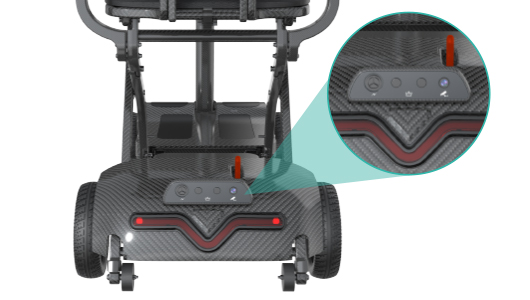
The F100 Pro combines a radar sensing module, rear-view camera, and other sensor components as part of its electronic architecture.
Each provides a different type of information.
The rear-view camera gives the user a visual reference of the area behind the scooter.
The sensing system provides additional information about objects within the monitored area.
Together, these components create a more connected approach to reverse maneuvering than relying on the driver's direct view alone.
This is especially relevant for users operating in residential areas, parking spaces, shopping environments, and other locations where nearby objects are common.
Turning Rear Visibility Into Driving Information
A camera can show what is behind the vehicle, but intelligent mobility goes one step further by connecting visual information with the vehicle's electronic system.
The F100 Pro is designed so that its rear-view camera and sensing components work within the same vehicle architecture.
This means reverse maneuvering is considered as part of the vehicle's overall electronic control system rather than as a separate camera accessory.
For the user, the practical value is greater awareness of the space behind the scooter.
For a distributor, this also provides a clearer way to explain the product.
The feature is not simply "a rear camera."
It is part of a reverse safety system that combines visibility and detection.
When Detection Leads to Automatic Stop
The next question after detecting an obstacle is what happens when the vehicle continues to move toward it.
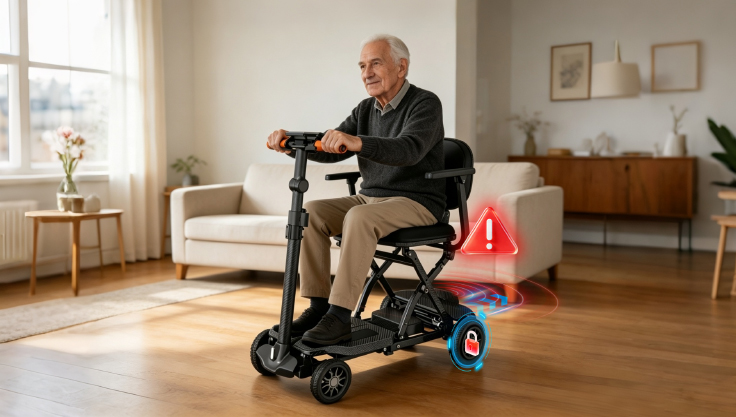
The F100 Pro includes reverse obstacle detection and automatic stop.
When the scooter detects an obstacle within the monitored area while reversing, the system can automatically stop the vehicle.
This adds a direct response to the detection process.
Instead of relying only on the user to recognize an obstacle and then react, the vehicle can provide an additional braking response.
The function is particularly relevant during close-range maneuvering, where the distance between the scooter and nearby objects can change quickly.
From Detection to Intelligent Assistance
The difference between a basic sensor and an intelligent safety function lies in how the information is used.
A sensor can detect something.
An intelligent mobility system can use that information as part of vehicle behavior.
F100 Pro combines sensing, electronic control, camera information, and automatic stopping into a single system.
This creates a more connected form of assistance.
The user continues to control the scooter, while the vehicle provides another layer of support when a monitored obstacle is detected during reversing.
People and Objects Create Different Situations
Not every obstacle behaves in the same way.
A parked object remains in one place.
A person can move into or across the vehicle's path.
This is why the F100 Pro also includes pedestrian collision emergency braking.
The function provides additional braking support when a pedestrian is detected within the monitored path.
For a mobility scooter used around homes, communities, shopping areas, and public spaces, this type of safety assistance addresses a different situation from static obstacle detection.
It expands the focus from the vehicle itself to the people moving around it.
Keeping the User at the Center
Intelligent assistance does not need to mean removing the user from control.
The F100 Pro is built around user-operated mobility, with electronic systems providing additional information and safety support when needed.
The driver still controls the scooter.
The electronic system monitors specific conditions.
The vehicle can provide an automatic response in defined situations.
This relationship is important for personal mobility because useful technology needs to support normal operation rather than make the vehicle harder to understand.
Why This Matters in Everyday Mobility
The value of reverse safety becomes clear in ordinary situations.
A user may reverse out of a parking space.
The scooter may need to move away from a wall.
A piece of furniture may be close behind the vehicle.
A pedestrian may enter the monitored path.
These situations do not require fully autonomous driving.
They require better awareness and an appropriate response when conditions become difficult to judge.
This is where the F100 Pro positions intelligent functions within a practical mobility scenario.
The Role of the Electronic Control System
The F100 Pro uses a self-developed electronic control system to coordinate key vehicle functions.
This provides the architecture needed to connect the digital instrument cluster, sensing modules, camera system, and safety functions.
The importance of this architecture is easy to overlook.
A camera, radar, display, or brake function on its own does not create a complete intelligent mobility experience.
The systems need to communicate with each other and respond according to the vehicle's operating conditions.
For the F100 Pro, electronic control is the layer that brings these functions together.
Making Vehicle Information Easier to Understand
Smart mobility is not only about automatic actions.
Users also need clear information while operating the vehicle.
The F100 Pro uses a 5-inch digital LCD display to provide vehicle information during operation.
This creates a connection between the vehicle's electronic systems and the user interface.
Instead of leaving intelligent functions entirely in the background, the product can make important vehicle information easier to understand while driving.
What This Adds to a Mobility Scooter
A conventional mobility scooter can provide powered movement.
A smart mobility scooter can add another layer around that basic function.
The F100 Pro combines:
Rear-view visibility
Radar sensing
Sensor integration
Reverse obstacle detection
Automatic stop
Pedestrian collision emergency braking
Digital vehicle information
These functions are not presented as separate technologies.
They are connected through the vehicle's electronic architecture to support a more informed driving experience.
Why This Is Relevant for Distributors
For distributors, intelligent safety features are easier to communicate when they are tied to situations customers recognize.
Instead of saying that a scooter is simply "smart," the product can be explained through specific use cases.
A customer concerned about reversing can understand the value of rear visibility and obstacle detection.
A customer who regularly moves around residential or shopping environments can understand the role of pedestrian emergency braking.
A customer who wants clearer information while driving can understand the value of a digital instrument cluster.
This makes the technology easier to translate into a product story.
What This Means for Brand and OEM Partners
For brands and OEM partners, intelligent safety can also become part of product positioning.
A smart mobility scooter can be developed around a defined set of electronic functions rather than adding unrelated features one by one.
The F100 Pro demonstrates how sensing, imaging, electronic control, display, and braking assistance can work together within a single mobility product.
This can provide a reference point for partners looking at more intelligent mobility configurations for specific markets.
A Practical Approach to Intelligent Mobility
The F100 Pro does not try to turn a mobility scooter into a fully autonomous vehicle.
Its approach is more practical.
The user remains the driver.
The vehicle provides additional environmental information.
The electronic system can respond to detected conditions.
The result is a form of intelligent assistance designed around situations that occur during normal mobility.
From Reverse Safety to Smarter Mobility
Reverse maneuvering is only one application, but it demonstrates an important direction in mobility product development.
As mobility scooters become more electronically integrated, sensing and safety functions can become part of the vehicle's operating system rather than separate accessories.
F100 Pro brings together rear vision, radar sensing, sensor integration, automatic obstacle stop, pedestrian emergency braking, and electronic control within one smart mobility scooter.
The result is a product that does more than provide transportation.
It provides additional awareness and assistance during specific driving situations.
Frequently Asked Questions
What makes the F100 Pro a smart mobility scooter?
F100 Pro integrates a self-developed electronic control system with a digital LCD display, radar sensing, rear-view camera, sensor integration, reverse obstacle detection, automatic stop, and pedestrian collision emergency braking.
How does F100 Pro support reverse maneuvering?
The F100 Pro combines rear-view camera information and sensing technology to provide additional awareness behind the scooter. When an obstacle is detected during reversing, the system can automatically stop the vehicle.
Does F100 Pro have automatic obstacle stop?
Yes. When an obstacle is detected within the monitored area during reversing, the system can automatically stop the scooter.
Does F100 Pro provide pedestrian emergency braking?
Yes. The F100 Pro includes pedestrian collision emergency braking to provide additional braking support when a pedestrian is detected within the monitored path.
Why is a rear-view camera useful on a mobility scooter?
A rear-view camera provides additional visibility behind the scooter, which can be useful when reversing, parking, or maneuvering near nearby objects.
Does intelligent assistance replace the user?
No. The user remains responsible for operating the scooter. Intelligent functions provide additional environmental information and safety assistance.
Why is electronic system integration important?
Electronic integration allows the sensing, camera, display, control, and safety functions to work as part of one vehicle system instead of operating as isolated components.
What does F100 Pro offer to distributors and OEM partners?
F100 Pro provides a smart mobility scooter platform with defined electronic and safety functions that can support product differentiation and market-specific mobility strategies.