
Navigating a compact apartment feels hard. A narrow hallway creates stress. A standard elevator leaves little room.
Size is not always the main issue. The real barrier is the space needed to change direction. A small turning radius changes this. It turns tight spaces into usable ones. Independence returns.
Why Tight Spaces Create Daily Frustration
Modern homes favor efficiency. Doorways stay narrow. Kitchens leave little free floor. Older elevators offer minimal clearance.
A chair with a wide turning circle forces three-point turns. Progress slows. Walls get scraped. Confidence drops.
In an elevator the user may reverse awkwardly. At home the path from bedroom to bathroom needs repeated corrections. Exhaustion builds. Willingness to move freely declines.
Turning radius measures the smallest circle a chair can complete. A smaller number needs less floor space. Chairs that pivot nearly in place open more of the home.
Understanding Turning Radius and What Makes It Small
Turning radius is more than a product number. It reflects drive design, wheel placement, and control precision.
Mid-wheel or well-tuned dual-motor systems let the chair rotate around its center. Front- or rear-wheel layouts need wider arcs. Sensitive joysticks and responsive motors shrink the required space further. Overall size helps, yet geometry and power matter more.
A typical hallway shows the difference. A 120 cm radius needs clear space many older homes lack. A 79 cm radius completes clean turns with far less room. The benefit appears at every doorway, corner, and elevator.
Key Features That Support Life in Confined Environments
A small turning radius works best with supporting design choices.
Compact Overall Footprint
Narrow width and modest length reduce the space the chair occupies when still. Parking beside a bed or sliding under a table becomes easier.
Responsive Dual Motors and Precise Control
Quiet dual motors with an intuitive joystick allow fine adjustments. Large corrections become rare. Movement stays smooth and measured.
Lightweight yet Rigid Construction
Extra weight makes precise control harder on soft floors or thresholds. A strong yet light frame improves response without losing stability.
Folding or Easy-Storage Capability
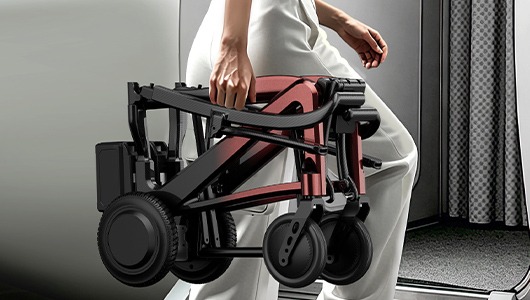
Even an agile chair benefits from folding. Storage in a small closet or car trunk turns practical.
Adequate Ground Clearance and Stability
Tight-space performance must stay safe. Modest clearance and a stable base prevent tipping on indoor thresholds.
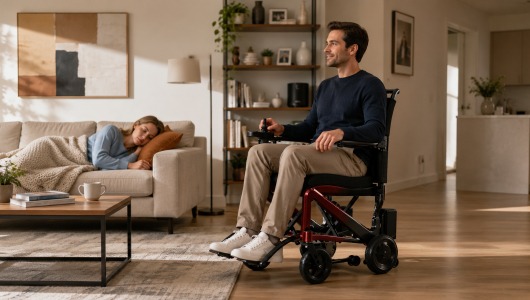
These elements combine. A small turning radius alone helps. Together with the features above, it becomes transformative.
Comparing Practical Options for Tight-Space Living
The table below shows how different designs perform where space is limited.
|
Feature |
Typical Larger Power Chair |
SCIFFTO S100 Compact |
SCIFFTO R100 Ultra-Light |
SCIFFTO E100 Foldable |
|
Turning Radius |
Often 100 cm+ |
79 cm |
Precise 360° steering |
Strong indoor focus |
|
Best Environment |
Open areas, outdoor |
Apartments, elevators, homes |
Travel + daily tight spaces |
Daily indoor + short trips |
|
Weight |
Higher |
30 kg |
~9.8 kg carbon fiber body |
~18.8 kg net (excl. battery) |
|
Portability |
Limited |
Practical daily transport |
Extreme one-person lifting |
One-step fold |
|
Indoor Agility |
Moderate |
Excellent |
High |
High |
|
Ideal User |
Those with more space |
Small-home residents |
Frequent travelers needing lightness |
Everyday portable needs |
The S100 delivers a documented 79 cm turning radius and strong indoor focus. The R100 adds extreme lightness and precise 360° steering for users who also travel. The E100 stresses compact folding and reliable daily indoor use. Effective mobility in tight spaces does not require compromise on every other need.
Real Situations Where a Small Turning Radius Makes the Difference
Moving Through a Compact Apartment
Furniture leaves little free floor. A chair that pivots cleanly beside a sofa or bed reduces rearrangements. Collisions drop. Mental load falls during routine moves.
Entering and Exiting Elevators
Standard elevators leave minimal clearance. A tight turning radius lets the user enter, face the doors, and exit without multi-point corrections. Independence in shared buildings rises.
Navigating Narrow Hallways and Doorways
Older homes and multi-unit buildings often have corridors barely wider than the chair. Precise control and a small radius allow accurate alignment. Scraping walls or frames becomes rare.
Restaurant Aisles and Public Interiors
Tight spaces appear outside the home too. A chair built for confined environments keeps social and practical outings feasible.
These situations share one result. Physical and cognitive effort drop. The chair works with the environment instead of against it. Daily life expands.
How to Evaluate Turning Performance Before Choosing
Specifications offer a start. Real evaluation needs more.
Request the exact turning radius. Observe a demonstration in a space like your own if possible. Watch low-speed behavior. Compare overall width to your narrowest doorways. Confirm the joystick gives fine, predictable input. Check whether the folded size fits your storage. Verify weight capacity and stability so agility does not reduce safety.
A chair that looks agile on paper can still feel cumbersome if control is imprecise or the footprint stays large. Numbers must match lived experience.
FAQs
What turning radius is small enough for most homes and elevators?
Figures around 80 cm or less work well in residential settings and standard elevators. Models under 80 cm, such as those with a 79 cm radius, give clear advantages in older or compact buildings.
Does a smaller turning radius reduce outdoor capability?
Not necessarily. Many chairs designed for tight indoor spaces still handle short outdoor trips, modest slopes, and common thresholds. Balanced engineering matters more than extreme specialization.
Can a lightweight chair still offer a tight turning radius?
Yes. Advanced materials such as carbon fiber and refined motor control allow both low weight and precise maneuverability. Ultra-light models combine easy lifting with strong indoor agility.
Is joystick control better than tiller control for tight spaces?
Joystick systems typically enable tighter, more intuitive turns. They support true pivoting. Tiller controls usually require wider arcs.
How important is overall chair width compared with turning radius?
Both matter. Width decides whether the chair fits through doorways. Turning radius decides how easily it reorients once inside. The best designs optimize both.
Will a chair with a small turning radius still feel stable?
Stability depends more on weight distribution, wheelbase design, and center of gravity than on turning radius alone. Well-engineered compact chairs stay secure while remaining agile.
Selecting the Right Solution for Confined Living
The ideal electric wheelchair for small homes, elevators, and tight spaces prioritizes a genuine small turning radius. It also needs compact dimensions, responsive controls, and practical portability.
Models that deliver a 79 cm radius, precise steering, and thoughtful packaging remove many daily barriers. Users in apartments, older buildings, or shared housing gain the most immediate benefit. Those who travel or need one-person handling gain extra value from ultra-light carbon fiber construction and quick folding.
The common thread stays the same. The ability to change direction with minimal space and minimal effort restores freedom.
Conclusion
A small turning radius is essential for electric wheelchair users in small homes, elevators, and tight spaces. It cuts extra movements. It protects confidence. It expands daily independence.
SCIFFTO focuses on these exact needs with models that deliver proven tight turning performance, compact size, and practical portability.
Explore the SCIFFTO range of compact power chairs today. Contact the SCIFFTO team for full specifications, personalized guidance, or customization options that match your space.