
Choosing a mobility scooter involves more than comparing product weight or appearance. Frame material, folding convenience, battery configuration, and safety functions all affect product suitability. SCIFFTO's F Series offers four configurations: F100-C, F100-M, F100 Pro, and F200, each designed with different features to meet varying mobility requirements.
What Should You Consider When Choosing a Mobility Scooter?
Before selecting a model, buyers should identify which specifications matter most to their target market. Product weight, frame construction, folding dimensions, and electronic assistance can all influence purchasing decisions.
Product Weight and Folding Convenience
For customers who regularly transport scooters by car or need to store them in limited spaces, product weight and folded dimensions deserve close attention.
A Lightweight Folding Mobility Scooter should be evaluated by more than its listed weight. Buyers also need to check whether batteries, armrests, cushions, and other removable components are included in the measurement.
SCIFFTO's F100 platform offers two frame configurations:
Both models feature manual folding and removable batteries. Different frame materials and carry weights give distributors more flexibility when selecting products for customers with different transportation and storage requirements.
Frame Material and Product Configuration
Frame material is another useful comparison point when selecting mobility scooters.
SCIFFTO uses carbon fiber and magnesium alloy across its F Series. F100-C and F100 Pro feature carbon fiber frames, while F100-M and F200 use magnesium alloy frames.
Rather than assuming one material suits every market, distributors should compare product weight, folded dimensions, and overall configuration before making purchasing decisions.
Safety Features During Reversing
Limited rear visibility can make reversing and parking challenging, particularly in confined spaces.
Mobility Scooter with Automatic Braking adds electronic assistance when its monitoring system detects obstacles within its operating area. Radar sensing and rear-view camera functions also provide additional information during reversing.
SCIFFTO F100 Pro and F200 both include rear-monitoring functions, but their electronic configurations differ. Buyers should check each model's specific functions and operating conditions before selecting a configuration.
Battery and Display Functions
Battery arrangements and dashboard design also influence product selection.
Standard F100 configurations use removable batteries and a 6-inch LCD screen. F100 Pro adds a Battery Management System (BMS), while F200 features a second-generation 5-inch TFT LCD dashboard and dual-battery management.
These differences help distributors compare everyday operation, battery monitoring, and electronic functions across the F Series.
SCIFFTO F Series Mobility Scooter Comparison
SCIFFTO offers four F Series configurations. All four models have a published maximum load capacity of 150 kg, but carry weight, frame material, and electronic functions differ.
|
Model |
Frame Material |
Carry Weight |
Maximum Load Capacity |
Main Features |
|
F100-C |
Carbon Fiber |
13 kg* |
150 kg |
Manual folding, removable battery |
|
F100-M |
Magnesium Alloy |
20 kg |
150 kg |
Manual folding, removable battery |
|
F100 Pro |
Carbon Fiber |
14 kg* |
150 kg |
Rear radar, camera, reverse obstacle detection, pedestrian emergency braking |
|
F200 |
Magnesium Alloy |
15 kg* |
150 kg |
AI-assisted reverse monitoring, TFT LCD, dual-battery management |
Carry weight excludes specified removable components and accessories. Refer to individual product specifications for exact exclusions.
Official product specifications:
F100-C: Lightweight Carbon Fiber Mobility Scooter
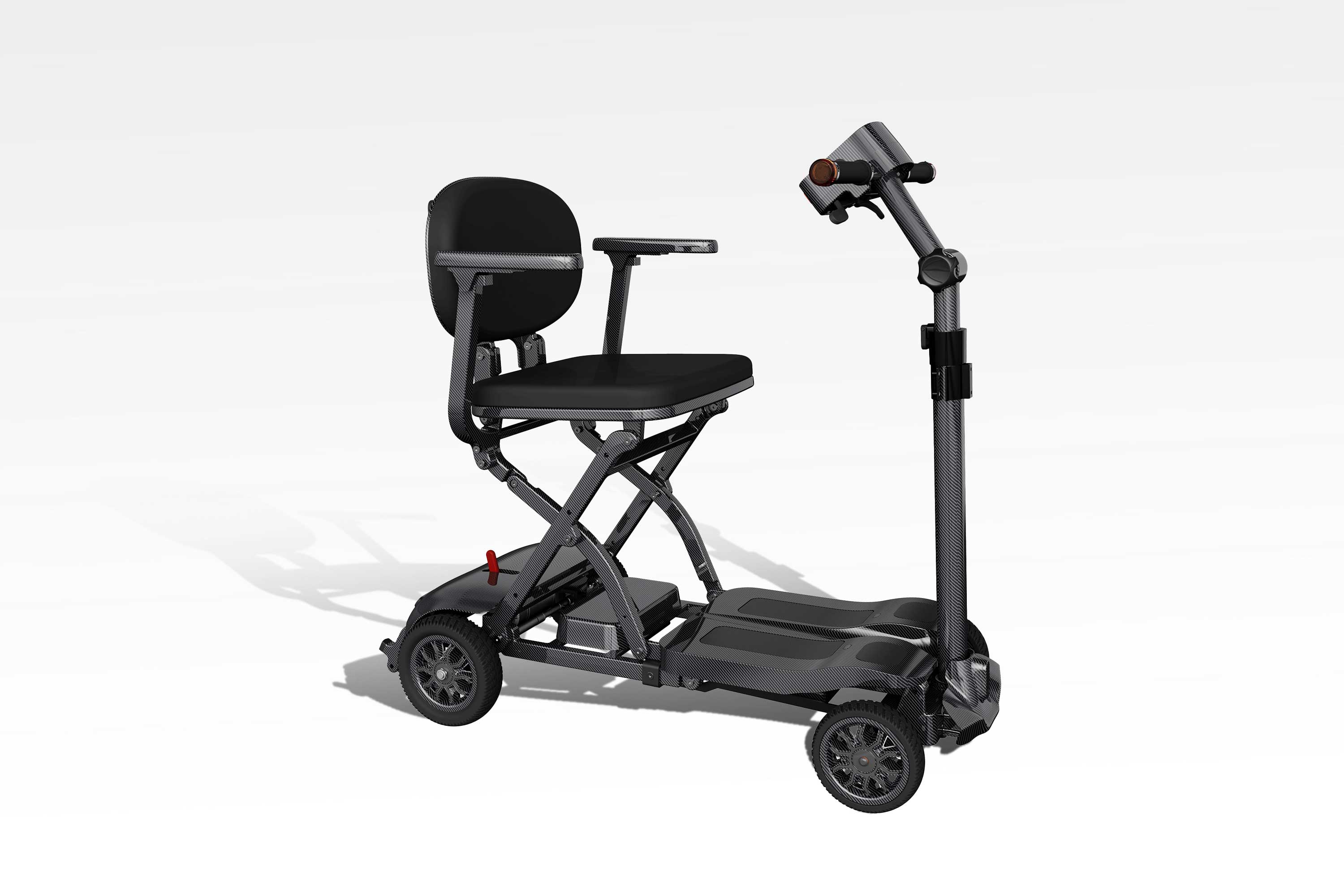
F100-C is the lightest configuration within the F100 platform, with a listed carry weight of 13 kg. Carbon fiber construction supports its lightweight folding design, while manual folding and removable batteries make storage and transportation more convenient.Despite such a lightweight configuration, F100-C still boasts a rated maximum load capacity of 150 kg.
|
Specification |
F100-C |
|
Frame |
Carbon Fiber |
|
Carry Weight |
13 kg* |
|
Maximum Load Capacity |
150 kg |
|
Motor |
180W |
|
Maximum Speed |
6 km/h |
|
Battery |
6Ah × 2 |
|
Driving Range |
20 km |
|
Display |
6-inch LCD |
|
Folding |
Manual |
|
Folded Dimensions |
73 × 49 × 50 cm |
Carry weight excludes removable armrests, cushions, battery, and spare parts or accessories.
For distributors targeting customers who prioritize portability, F100-C offers a lightweight folding configuration without compromising its published load capacity. Look over F100-C and F100-M Mobility Scooter Specifications
F100-M: Magnesium Alloy Mobility Scooter
F100-M provides an alternative frame configuration within the F100 platform. It uses magnesium alloy and has a listed carry weight of 20 kg.
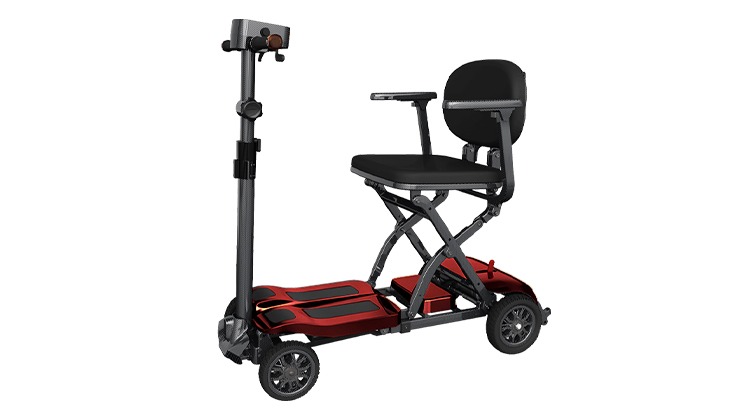
Both F100 configurations share a maximum load capacity of 150 kg, 180W motor, 6Ah × 2 battery configuration, and 6-inch LCD screen. Main differences include frame material, carry weight, and folded dimensions.
|
Specification |
F100-M |
|
Frame |
Magnesium Alloy |
|
Carry Weight |
20 kg |
|
Maximum Load Capacity |
150 kg |
|
Motor |
180W |
|
Maximum Speed |
6 km/h |
|
Battery |
6Ah × 2 |
|
Driving Range |
20 km |
|
Display |
6-inch LCD |
|
Folding |
Manual |
|
Folded Dimensions |
78 × 50 × 50 cm |
F100-M gives distributors another frame option within the same product platform. Comparing it with F100-C helps buyers identify which configuration better matches transportation, storage, and product positioning requirements. Look for F100-C and F100-M Mobility Scooter Specifications.
Mobility Scooter AEB: How F100 Pro Adds Electronic Safety Assistance
For buyers looking beyond basic folding and mobility functions, electronic safety features can become an important product selection factor.
F100 Pro combines radar sensing, rear-view camera monitoring, multi-sensor integration, and automatic stopping support. Its electronic configuration provides additional assistance during reversing and maneuvering.
Rear Radar and Reverse Obstacle Detection
F100 Pro uses a radar sensing module to monitor areas behind the scooter. When the system detects an obstacle within its monitored area during reversing, it can automatically stop the scooter.
https://www.scifftomobility.com/attachment/209/source/scifto-F100-Pro-1_238747.jpg
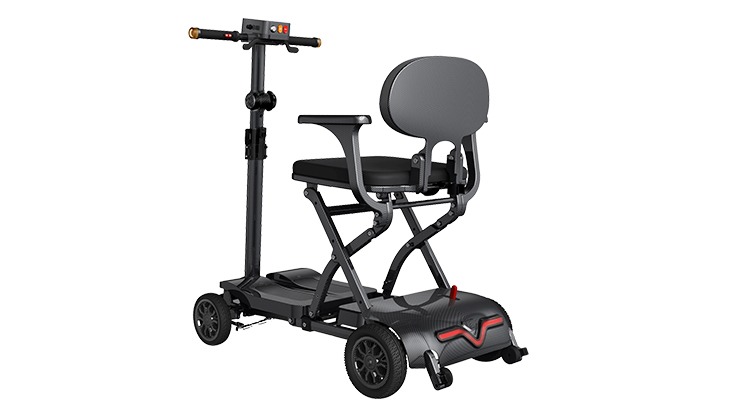
This is the main function behind its Reverse Obstacle Detection Scooter configuration.
Rear-view camera provides additional visual information, while radar sensing supports obstacle monitoring. Together, these functions help users assess surroundings during reversing.
Pedestrian Collision Emergency Braking
F100 Pro also includes Pedestrian Collision Emergency Braking.
When the system detects a pedestrian within its monitored path, it provides additional braking support. This function adds another layer of electronic assistance to the scooter's reversing safety configuration.
For buyers evaluating an Automatic Emergency Braking Mobility Scooter, it is important to distinguish between individual functions. Rear obstacle detection, automatic stopping, and pedestrian emergency braking each address specific monitored situations.
F100 Pro's published specifications confirm support for these functions.
F100 Pro Specifications
|
Specification |
F100 Pro |
|
Frame |
Carbon Fiber |
|
Carry Weight |
14 kg* |
|
Maximum Load Capacity |
150 kg |
|
Motor |
180W |
|
Maximum Speed |
6 km/h |
|
Battery |
6Ah × 2 |
|
Driving Range |
25 km |
|
Display |
5-inch Digital LCD |
|
Charge Output |
Type-C |
|
Folding |
Manual |
|
Folded Dimensions |
73 × 49 × 50 cm |
|
Rear Radar |
Supported |
|
Rear-View Camera |
Supported |
|
Reverse Obstacle Detection |
Supported |
|
Automatic Stop |
Supported |
|
Pedestrian Collision Emergency Braking |
Supported |
|
Battery Management |
BMS |
Carry weight excludes removable armrests, cushions, battery, and all spare parts and accessories.
F100 Pro is a suitable option for distributors who want to add a smart mobility scooter with integrated electronic control and rear safety assistance to their product range.For F100 Pro Smart Mobility Scooter
F200: AI-Assisted Reverse Safety and Dual-Battery Management
F200 combines magnesium alloy construction and manual folding with radar-assisted reverse monitoring, rear-view camera functions, and dual-battery management.
Its electronic configuration makes it another option for buyers comparing a Mobility Scooter with Automatic Braking.
AI-Assisted Reverse Monitoring
F200 integrates rear radar monitoring and reverse obstacle detection. During reversing, radar monitors distance behind the scooter and provides warnings when obstacles are too close.
Rear-view camera feed appears automatically during reversing, helping users observe surroundings.
https://www.scifftomobility.com/attachment/209/source/f200_smart_mobility_scooter_main_245549.jpg
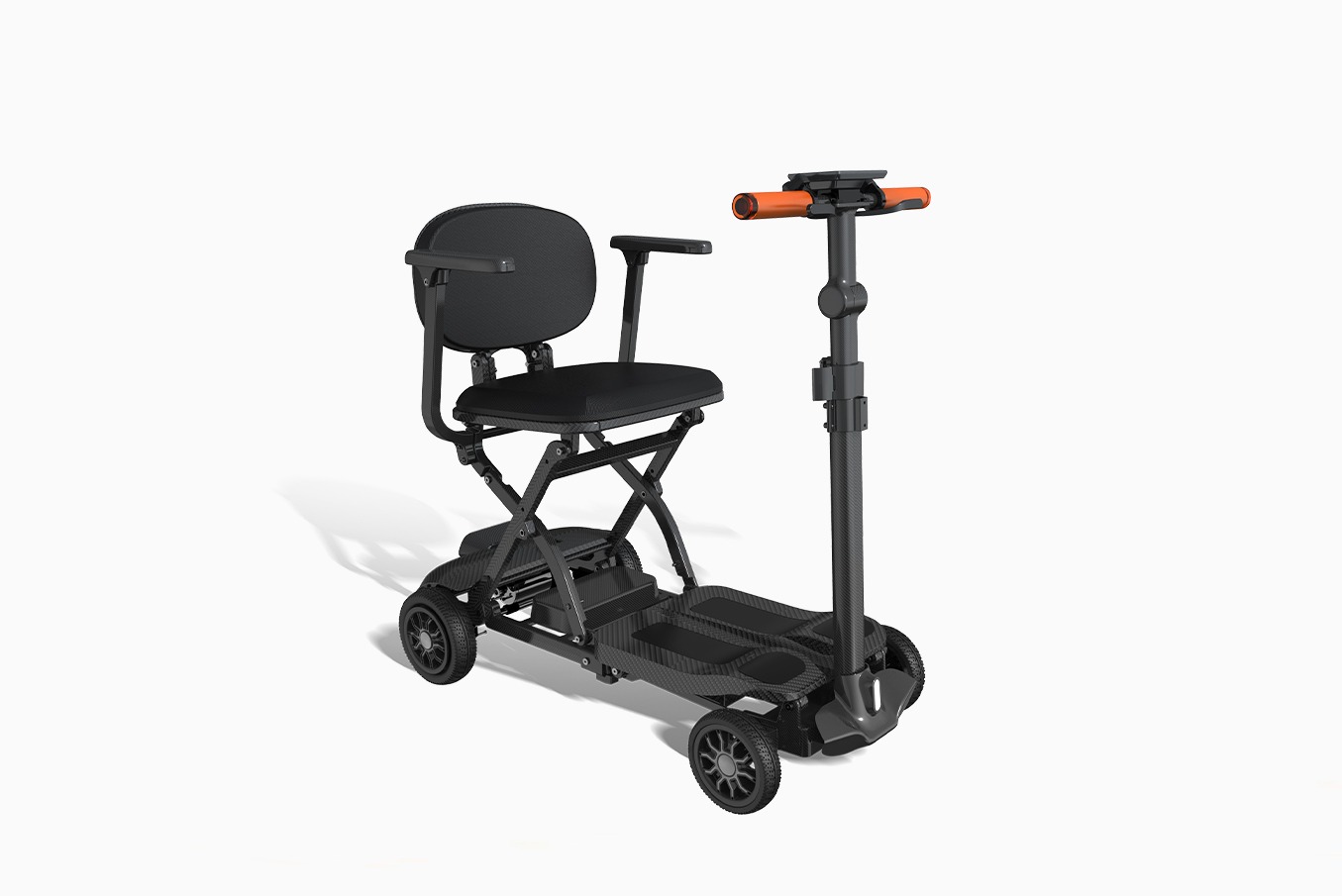
F200 also supports automatic stopping when an obstacle is detected during reversing, including pedestrian emergency-stop support when a pedestrian enters the monitored path.
These functions provide additional assistance in parking areas, residential environments, and other spaces where reversing requires more attention.
Second-Generation TFT LCD Dashboard
F200 features a second-generation 5-inch TFT LCD digital dashboard with a customizable graphical interface.
Display provides vehicle information and brings key operating functions together. Its customizable interface also gives F200 a different dashboard configuration from standard F100 and F100 Pro.
Dual-Battery Management
F200 includes a dual-battery management system with:
- Battery priority settings.
- Low-battery warnings.
- Display updates when one battery is removed.
- Battery monitoring and charging management.
These functions provide buyers with another point of comparison when evaluating battery management across F Series.
F200 Specifications
|
Specification |
F200 |
|
Frame |
Magnesium Alloy |
|
Carry Weight |
15 kg* |
|
Maximum Load Capacity |
150 kg |
|
Motor |
180W |
|
Maximum Speed |
6 km/h |
|
Battery |
6Ah × 2 |
|
Driving Range |
20 km |
|
Display |
Second-Generation 5-inch TFT LCD |
|
Charge Output |
Type-C |
|
Front Wheels |
7-inch Solid |
|
Rear Wheels |
8-inch Solid |
|
Folding |
Manual |
|
Unfolded Dimensions |
96 × 50 × 100 cm |
|
Folded Dimensions |
78 × 50 × 50 cm |
|
Rear Radar Monitoring |
Supported |
|
Rear-View Camera |
Supported |
|
Reverse Obstacle Detection |
Supported |
|
Automatic Stop During Reversing |
Supported |
|
Pedestrian Emergency Stop During Reversing |
Supported |
|
Dual-Battery Management |
Supported |
15 kg carry weight excludes removable armrests, cushions, batteries, and spare parts.
F200 gives distributors another smart mobility scooter configuration to consider. Magnesium alloy construction, 15 kg listed carry weight, TFT LCD dashboard, and dual-battery management distinguish it from F100 Pro. This is F200 Smart Mobility Scooter
F100 Pro vs F200: Which Smart Mobility Scooter Should You Choose?
F100 Pro and F200 both offer rear radar monitoring, reverse obstacle detection, automatic stopping support, and pedestrian-related emergency braking or stopping functions.
However, their specifications and electronic configurations differ.
|
Comparison |
F100 Pro |
F200 |
|
Frame Material |
Carbon Fiber |
Magnesium Alloy |
|
Carry Weight |
14 kg* |
15 kg* |
|
Maximum Load Capacity |
150 kg |
150 kg |
|
Display |
5-inch Digital LCD |
5-inch TFT LCD |
|
Rear Radar |
Yes |
Yes |
|
Rear-View Camera |
Yes |
Yes |
|
Reverse Obstacle Detection |
Yes |
Yes |
|
Automatic Stop During Reversing |
Yes |
Yes |
|
Pedestrian Function |
Pedestrian Collision Emergency Braking |
Pedestrian Emergency Stop During Reversing |
|
Battery Management |
BMS |
Dual-Battery Management |
Weight exclusions differ by model.
Choose F100 Pro when carbon fiber construction, listed carry weight, and integrated electronic control system are important considerations.
Consider F200 when magnesium alloy construction, second-generation TFT LCD dashboard, and dual-battery management better match intended product requirements.
Both models provide electronic assistance during reversing, but buyers should review individual specifications rather than treat their safety systems as identical.
How to Build a Mobility Scooter Product Range
For distributors and mobility equipment suppliers, offering several configurations can help address different purchasing priorities.
SCIFFTO's F Series can be organized around three practical product requirements.
Portability and folding convenience
F100-C and F100-M provide two frame options within standard F100 platform. Manual folding structures and removable batteries support storage and transportation requirements.
Electronic safety assistance
F100 Pro combines radar sensing, rear-view camera monitoring, reverse obstacle detection, automatic stopping, and pedestrian collision emergency braking.
Smart dashboard and battery management
F200 adds second-generation TFT LCD dashboard and dual-battery management alongside rear monitoring and obstacle detection functions.
This structure helps buyers distinguish products by their actual specifications and functions. It also gives distributors a clearer way to present product differences without relying on price or appearance alone.
Conclusion
SCIFFTO's F Series offers four mobility scooter configurations with different frame materials, carry weights, and electronic functions. From lightweight folding structures to radar-based reverse assistance and dual-battery management, each model addresses different purchasing priorities.Contact SCIFFTO to discuss product specifications, model selection, and OEM/ODM cooperation.
Frequently Asked Questions
What Is Mobility Scooter AEB?
Mobility Scooter AEB refers to an automatic emergency braking function designed to provide braking support when the system detects an obstacle or pedestrian within its monitored area. SCIFFTO F100 Pro includes rear radar obstacle detection, automatic stopping during reversing, and pedestrian collision emergency braking.
Which SCIFFTO Mobility Scooter Supports Pedestrian Collision Emergency Braking?
F100 Pro lists Pedestrian Collision Emergency Braking in its official specifications. F200 separately lists pedestrian emergency-stop support during reversing. Buyers should check the exact function and operating conditions of each model.
Does F200 Have Reverse Obstacle Detection?
Yes. F200 supports rear radar monitoring, reverse obstacle detection, and automatic stopping support during reversing. Its rear-view camera also displays automatically during reversing.
What Is the Difference Between F100-C and F100-M?
F100-C uses a carbon fiber frame and has a listed carry weight of 13 kg. F100-M uses a magnesium alloy frame and has a listed carry weight of 20 kg. Both have a 150 kg maximum load capacity and share main F100 platform features.
Which F Series Model Is Suitable for Buyers Prioritizing Portability?
F100-C has the lowest listed carry weight in the F Series at 13 kg. Buyers should also compare folded dimensions and components excluded from carry-weight measurement before making a final decision.